Leoben Town Parish Church · St. Xavier

Leoben, Austria

About this church

Town parish church · Leoben’s most important church in terms of art history

Significance: Conceived as a 'Palais of God', St. Xavier's with its high altar and Romanesque cross is one of the most art-historically important churches in Styria.

Special features: Romanesque cross from the Aquileia school, 17 meter high high altar, year-round nativity scene

Admission: Free

Accessibility: Yes

Guided tours: Upon request

Highlights
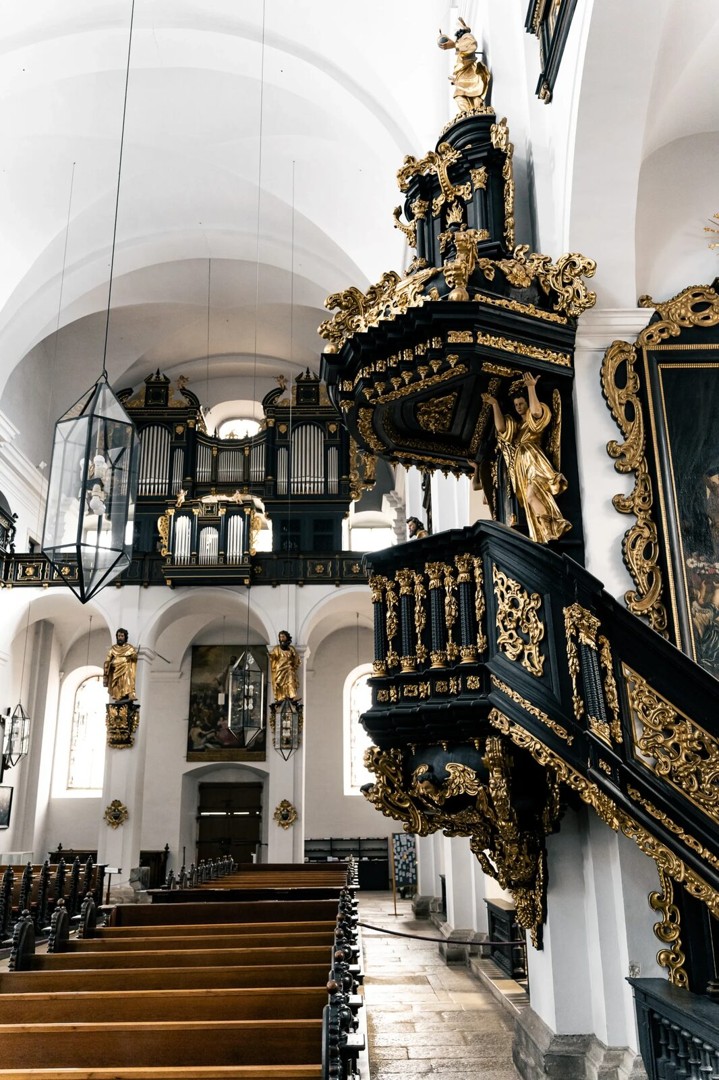
The pulpit The pulpitLocation: In the church interior (sermon pulpit) Dating: 17th century (during the construction of the church) Material/Type: Pulpit (sermon pulpit) The pulpit was literally a 'teaching pulpit': sermons were delivered from here that not only conveyed pious edification, but also knowledge. The Jesuits also taught at the attached school - the first Latin school in the area and the second in the entire Styria. In a time without television, the Internet or newspapers, creation, nature and the cosmos were explained from here to show that nature is God's creation and life is a gift.Read more Organs and music (communion grille & organ gallery) Organs and music (communion grille & organ gallery)Location: Front chancel (communion grille) and organ gallery in the rear of the church Dating: First organ 1914 (unfinished); new organ landscape 2004–2010 Material/Type: Two organs The communion grid running across the chancel is a reminder that music was originally made here: priests, organs, instruments and choir formed the great classical Mass oratorios, while the people experienced the liturgy more as a theatrical event. In 1914 a large organ was built in the organ gallery (former Adelsplatz), which was never completed due to the First World War. A new organ landscape was planned from 2004; Both organs were completed in 2010.Read more The high altar The high altarLocation: Chancel Dating: 17th century (during the construction of the church 1660–1665) Material / Type: High altar, wood (black and gold frame), approx. 17 meters high At 17 meters, one of the highest and most impressive altars in Styria, it shows the Assumption of Mary: below the astonished apostles at the empty tomb, above Mary with angels ascending to God the Father, Son and Holy Spirit. The altar is built like a window open to heaven; Columns wrapped in vines underline the paradisiacal character. Black stands for the earthly night, gold for divine splendor and eternity - the message: death is not the end.Read more The crib The cribLocation: In the church interior (exact location not specified in the source material) Dating: Probably Baroque period (17th/18th century) Material/Type: Carved figures, designed as a year-round nativity scene A recently rediscovered gem, probably from the Baroque period. Unlike a pure Christmas nativity scene, it is designed as a year-round nativity scene: it shows different scenes throughout the church year, from the birth of Christ to the Adoration of the Magi to the flight into Egypt. The expressively carved, lavishly dressed figures were consciously brought back into focus - as a low-threshold medium, especially for children and people with easy access to faith.Read more The Altarpiece (Theatrum Sacrum) The Altarpiece (Theatrum Sacrum)Location: High altar / chancel Dating: 17th century (Baroque period) Material/Type: Theater backdrop/stage setup instead of a classic painting Not a classic painted picture, but a theater backdrop set up like a stage in the spirit of the baroque 'Theatrum Sacrum'. The Assumption of Mary is staged in such a way that the viewer feels like a witness to the event; the arrangement of figures creates movement and draws the eye from the earth into the open sky. A medium of its time to show the glory of God and the hope of eternal life to even those who did not know how to read - 'the cinema of the baroque'.Read more Relics and the Saint Victorian Relics and the Saint VictorianLocation: In the church interior Dating: Relic acquired in the 19th century Material/Type: Wax figure in Roman clothing with relic In the Baroque period, the number of relics in a church was considered a great treasure; they were collected and also purchased. A relic acquired in the 19th century is that of St Victorian, who was given a place of honor. The relic was sculpted into a human figure with wax and dressed in Roman clothing; A cut throat, visible upon closer inspection, identifies him as a martyr. He was probably a Roman soldier or officer.Read more The gravestones The gravestonesLocation: Inside the church (former gravestones from the outside cemetery have been preserved inside); Additionally, unrestored crypt under the church Dating: Historical, exact date not specified in source material Material/Type: Tombstones/Epitaphs Traditionally, the parish concept was divided into three parts: the dead under the church, a cemetery around it, the living on earth, the saints above as an image of the future. The outer cemetery no longer exists today, but valuable gravestones have been preserved inside - including that of an auxiliary bishop of Styria and abbot of Rein Abbey, depicted as a Renaissance prince with around 16 rings on his hands. In addition, there is a large, unrestored, inaccessible crypt under the church.Read more The Romanesque Cross The Romanesque CrossLocation: In the church interior (exact location not specified in the source material) Dating: Romanesque/early Gothic, origin unknown for a long time Material / type: stone cross (Romanesque/early Gothic) Artist/Maker: School of Aquileia One of the great treasures of Leoben: a Romanesque or early Gothic cross from the school of Aquileia, in size and design there is no comparable counterpart anywhere. For a long time the origin was unknown; About ten years ago it was exhibited in Cividale as a major attraction, in the presence of church dignitaries and representatives of the Ministry of Culture.Read more
StoryA place where faith, art, music and history come together.Read more dedicationdedicationRead more Renovations & extensionsRenovations & extensionsRead more Special storySpecial storyRead more
The pulpit

The pulpit

Location: In the church interior (sermon pulpit)
Dating: 17th century (during the construction of the church)
Material/Type: Pulpit (sermon pulpit)
The pulpit was literally a 'teaching pulpit': sermons were delivered from here that not only conveyed pious edification, but also knowledge. The Jesuits also taught at the attached school - the first Latin school in the area and the second in the entire Styria. In a time without television, the Internet or newspapers, creation, nature and the cosmos were explained from here to show that nature is God's creation and life is a gift.
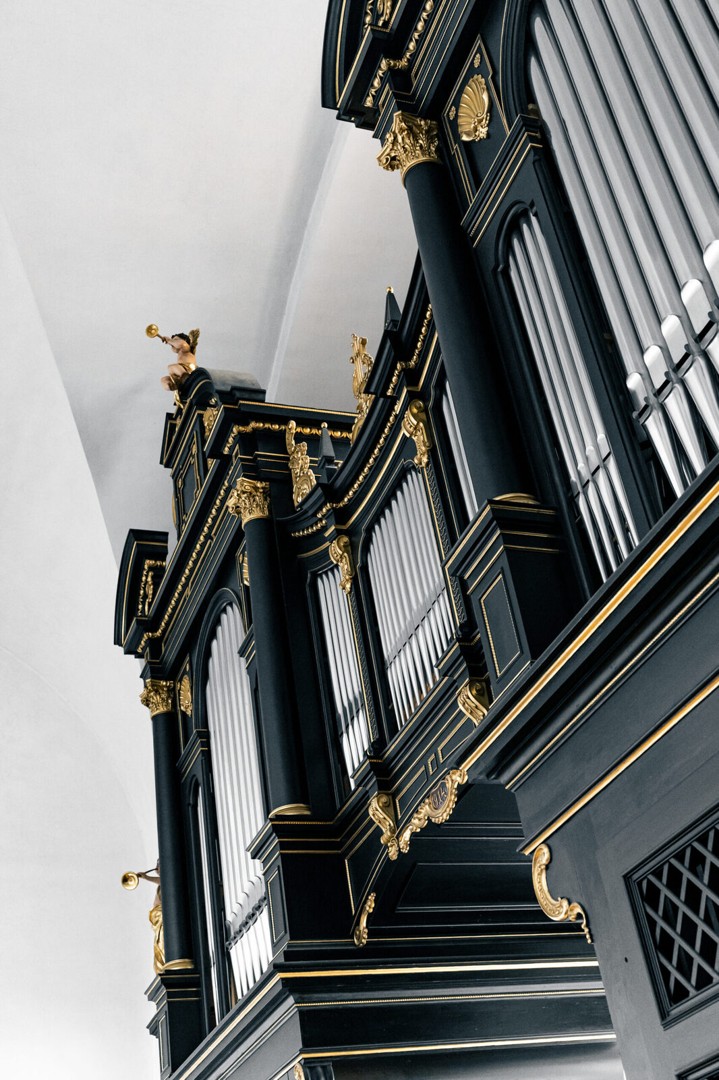
Organs and music (communion grille & organ gallery)

Organs and music (communion grille & organ gallery)

Location: Front chancel (communion grille) and organ gallery in the rear of the church
Dating: First organ 1914 (unfinished); new organ landscape 2004–2010
Material/Type: Two organs
The communion grid running across the chancel is a reminder that music was originally made here: priests, organs, instruments and choir formed the great classical Mass oratorios, while the people experienced the liturgy more as a theatrical event. In 1914 a large organ was built in the organ gallery (former Adelsplatz), which was never completed due to the First World War. A new organ landscape was planned from 2004; Both organs were completed in 2010.
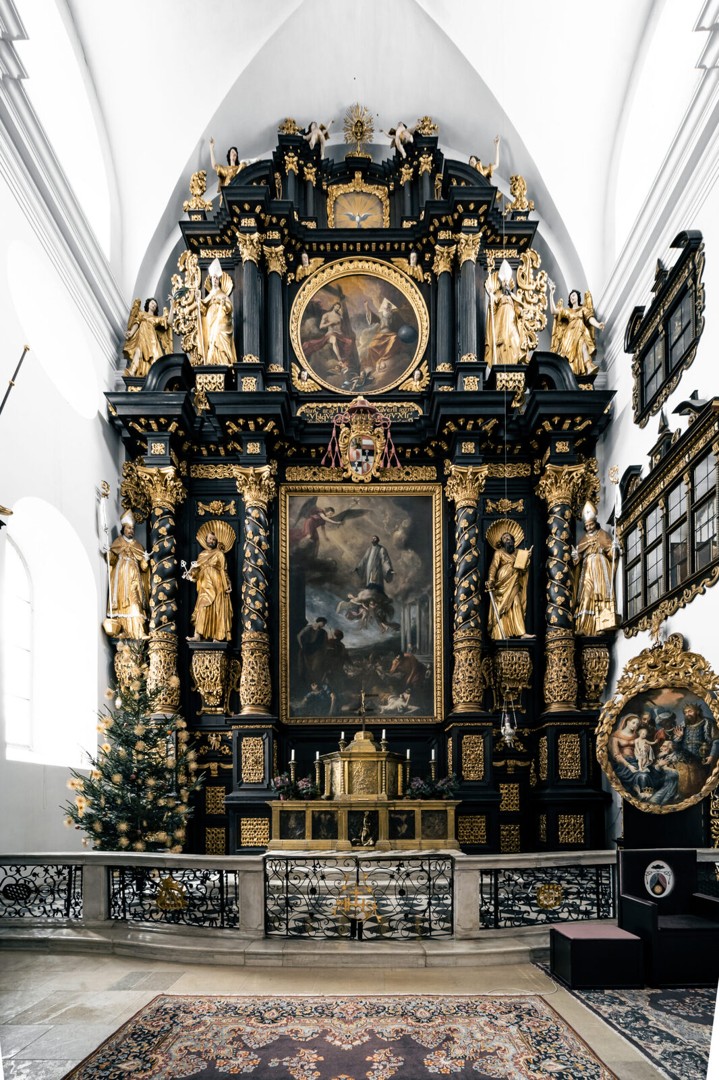
The high altar

The high altar

Location: Chancel
Dating: 17th century (during the construction of the church 1660–1665)
Material / Type: High altar, wood (black and gold frame), approx. 17 meters high
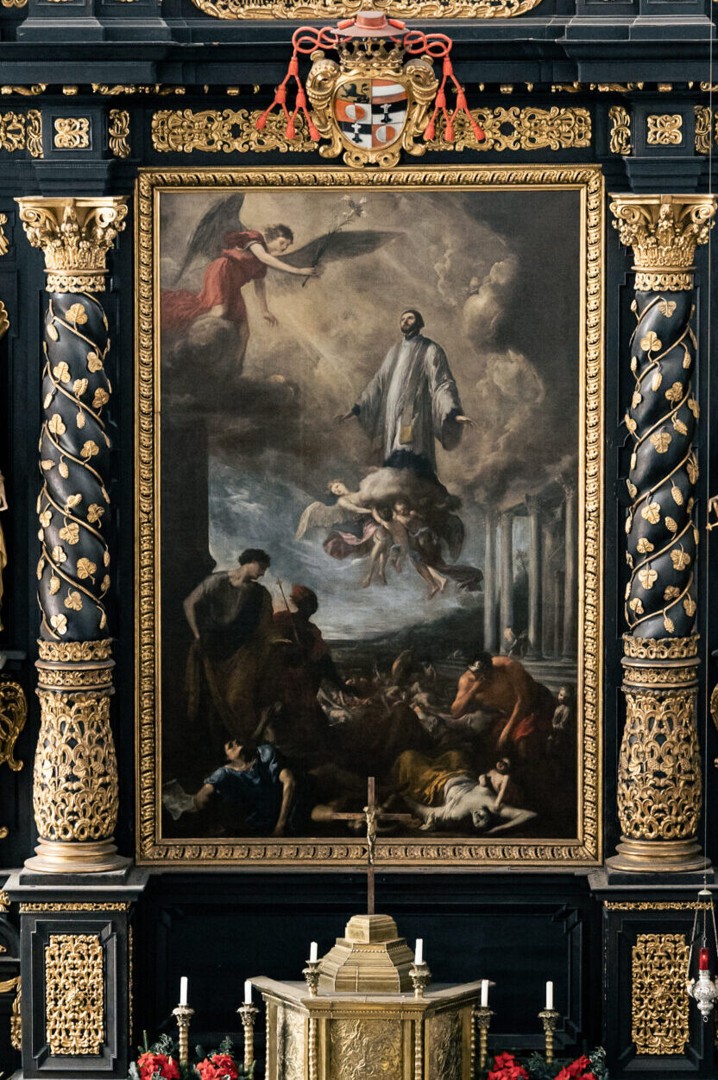
At 17 meters, one of the highest and most impressive altars in Styria, it shows the Assumption of Mary: below the astonished apostles at the empty tomb, above Mary with angels ascending to God the Father, Son and Holy Spirit. The altar is built like a window open to heaven; Columns wrapped in vines underline the paradisiacal character. Black stands for the earthly night, gold for divine splendor and eternity - the message: death is not the end.
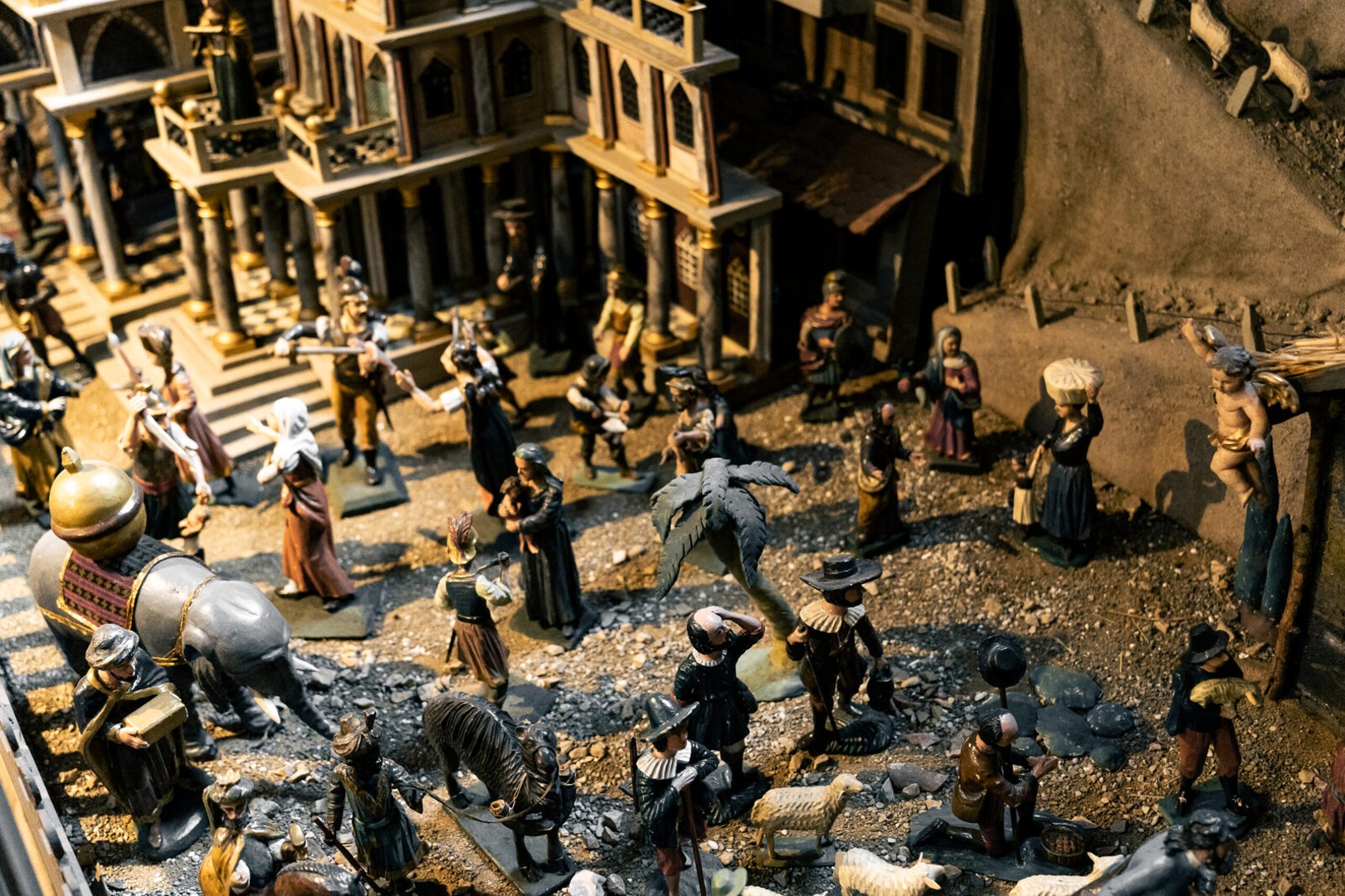
The crib

The crib

Location: In the church interior (exact location not specified in the source material)
Dating: Probably Baroque period (17th/18th century)
Material/Type: Carved figures, designed as a year-round nativity scene
A recently rediscovered gem, probably from the Baroque period. Unlike a pure Christmas nativity scene, it is designed as a year-round nativity scene: it shows different scenes throughout the church year, from the birth of Christ to the Adoration of the Magi to the flight into Egypt. The expressively carved, lavishly dressed figures were consciously brought back into focus - as a low-threshold medium, especially for children and people with easy access to faith.
The Altarpiece (Theatrum Sacrum)

The Altarpiece (Theatrum Sacrum)

Location: High altar / chancel
Dating: 17th century (Baroque period)
Material/Type: Theater backdrop/stage setup instead of a classic painting
Not a classic painted picture, but a theater backdrop set up like a stage in the spirit of the baroque 'Theatrum Sacrum'. The Assumption of Mary is staged in such a way that the viewer feels like a witness to the event; the arrangement of figures creates movement and draws the eye from the earth into the open sky. A medium of its time to show the glory of God and the hope of eternal life to even those who did not know how to read - 'the cinema of the baroque'.
Relics and the Saint Victorian

Relics and the Saint Victorian

Location: In the church interior
Dating: Relic acquired in the 19th century
Material/Type: Wax figure in Roman clothing with relic
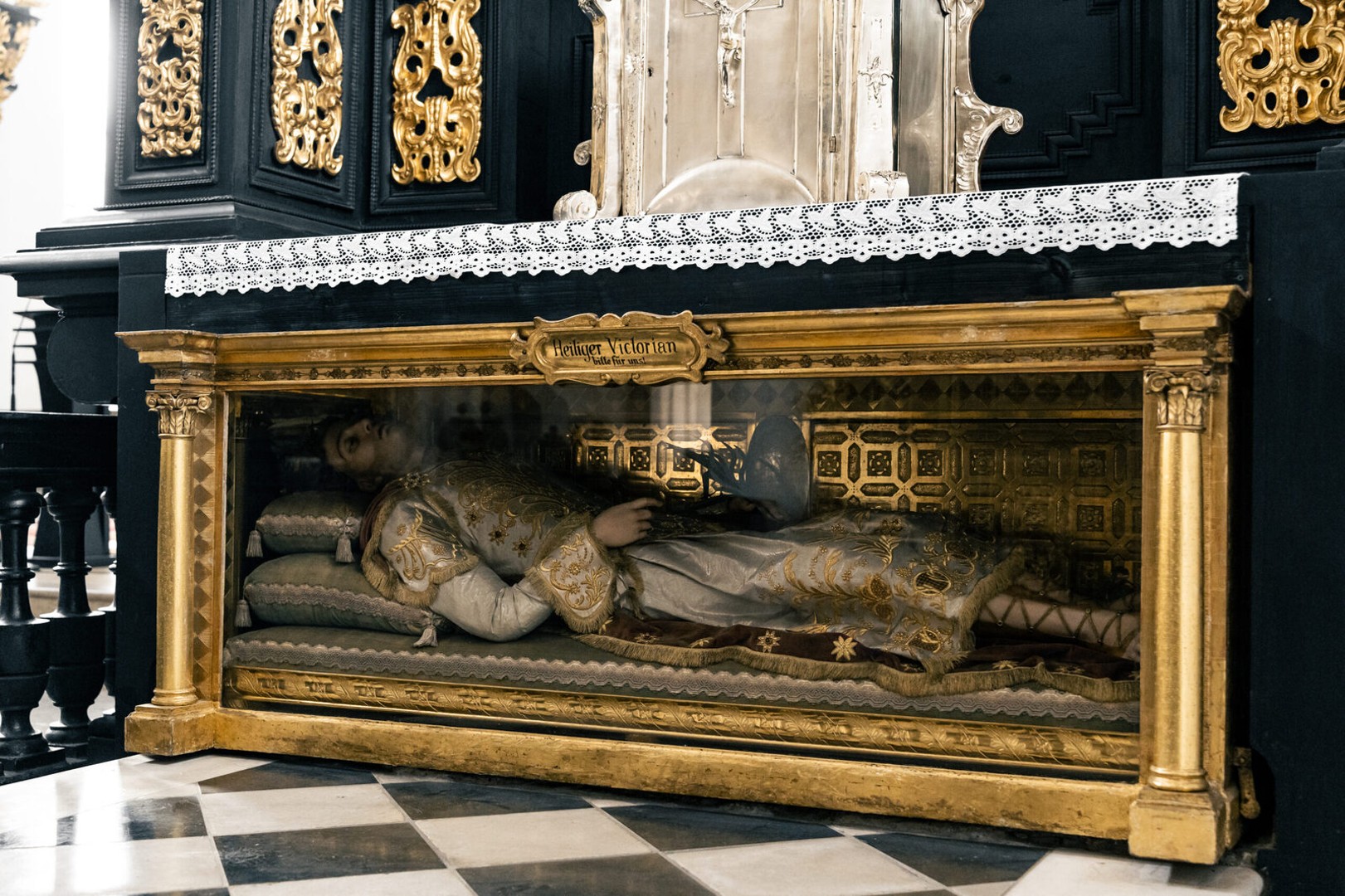
In the Baroque period, the number of relics in a church was considered a great treasure; they were collected and also purchased. A relic acquired in the 19th century is that of St Victorian, who was given a place of honor. The relic was sculpted into a human figure with wax and dressed in Roman clothing; A cut throat, visible upon closer inspection, identifies him as a martyr. He was probably a Roman soldier or officer.
The gravestones

The gravestones

Location: Inside the church (former gravestones from the outside cemetery have been preserved inside); Additionally, unrestored crypt under the church
Dating: Historical, exact date not specified in source material
Material/Type: Tombstones/Epitaphs
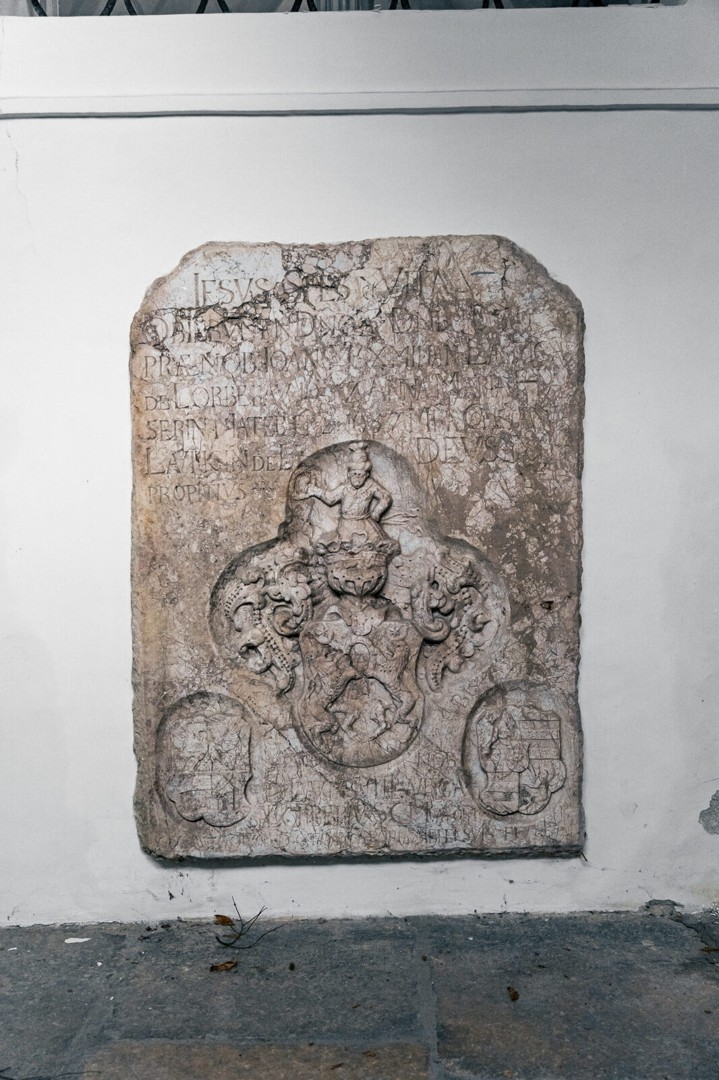
Traditionally, the parish concept was divided into three parts: the dead under the church, a cemetery around it, the living on earth, the saints above as an image of the future. The outer cemetery no longer exists today, but valuable gravestones have been preserved inside - including that of an auxiliary bishop of Styria and abbot of Rein Abbey, depicted as a Renaissance prince with around 16 rings on his hands. In addition, there is a large, unrestored, inaccessible crypt under the church.
The Romanesque Cross

The Romanesque Cross

Location: In the church interior (exact location not specified in the source material)
Dating: Romanesque/early Gothic, origin unknown for a long time
Material / type: stone cross (Romanesque/early Gothic)
Artist/Maker: School of Aquileia
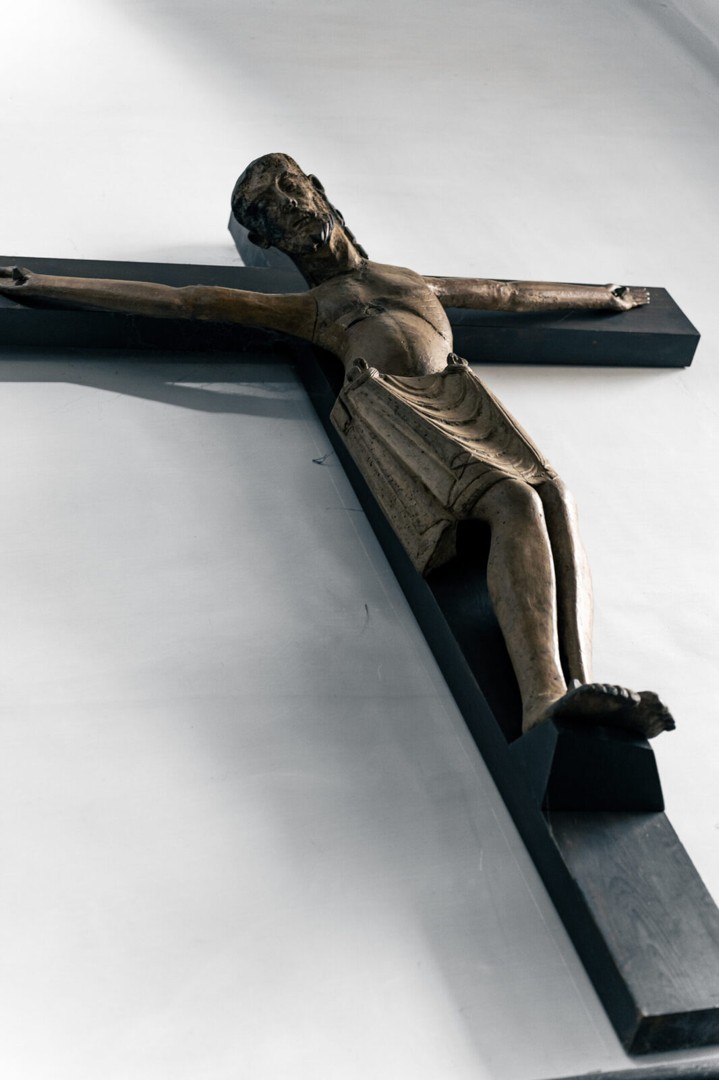
One of the great treasures of Leoben: a Romanesque or early Gothic cross from the school of Aquileia, in size and design there is no comparable counterpart anywhere. For a long time the origin was unknown; About ten years ago it was exhibited in Cividale as a major attraction, in the presence of church dignitaries and representatives of the Ministry of Culture.
Story

Story

A place where faith, art, music and history come together.

The Church of St. Xavier in Leoben is an impressive baroque gem that combines history, art and spirituality in a unique way. As soon as they enter, visitors are fascinated by the harmonious architecture and the lovingly designed details inside.
Its origins date back to 1612, when the emperor initiated a Catholic reform. Education and a renewed liturgy became central goals that were implemented primarily by the Jesuit order.
The church was built between 1660 and 1665 by the Carlone family and financed by Christoph Janschitsch. It was created as a baroque work of art, as a so-called “Palais of God”.
In the 17th and 18th centuries, the Baroque all-season nativity scene developed, and music became an important part of the liturgy. Performances in the chancel made the church a lively place of faith.
Between 2004 and 2010, a new organ landscape was created that continues the musical tradition. Today, church services and cultural events take place regularly.

dedication

dedication

The parish church is dedicated to Saint Francis Xavier. Originally built as a Jesuit church, it was elevated to a city parish church in 1811. The entire spatial concept is intended as a 'Palace of God': a place where everyone is welcome, regardless of origin, education or social status - in contrast to the secular palaces of the time they were built, which were only open to the nobility and wealthy.

Renovations & extensions

Renovations & extensions

- 1811: Elevation from the Jesuit church to the town parish church.
- 1914: Construction of a large organ in today's organ gallery (where the nobility used to sit); never completed due to the First World War.
- 2004–2010: Planning and implementation of a new organ landscape; Both organs were completed in 2010.

Special story

Special story

The Romanesque or early Gothic cross from the Aquileia school was of unknown origin for a long time; About ten years ago it was exhibited in Cividale as a major attraction, in the presence of church dignitaries and representatives of the Ministry of Culture.
The church was built as part of the Catholic reform initiated by the emperor in 1612; The Jesuits first built the school - the first Latin school in the area and the second in all of Styria - and only then the church, financed by the Vordernberg councilor Christoph Janschitsch.
Among the preserved gravestones is that of an auxiliary bishop of Styria, who was also abbot of Rein Abbey and pastor of Leoben-St. Xavier - depicted as a Renaissance prince with around 16 rings on his hands, an image that, according to tradition, was one of the reasons for the uprisings against the clergy at the time.
The relic of St. Victorian, probably a Roman soldier or officer, was fashioned in the 19th century as a wax figure in Roman clothing; a depicted cut throat identifies him as a martyr.

Audio guide

Origin & History1:29
The concept - Palace of God1:33
The high altar1:16
The pulpit1:04
The Romanesque cross1:01
Organs and music1:03
The Christmas nativity scene0:51
The relic of Saint Victorian0:53
The gravestones1:02

Videos

Discover Leoben Town Parish Church · St. Xavier

Sign in