Graz-Andritz · St. Vitus

Graz, Austria

About this church

Parish church · ecclesiastical centre of Graz-Andritz

Significance: The ecclesiastical center of Graz-Andritz since the Middle Ages - in 2026 the parish church of St. Veit will celebrate its 800th anniversary (first mentioned in 1226).

Special features: Art-historically important, regionally important, village significance of the entire complex

Accessibility: Not specified

Guided tours: Not specified

Highlights
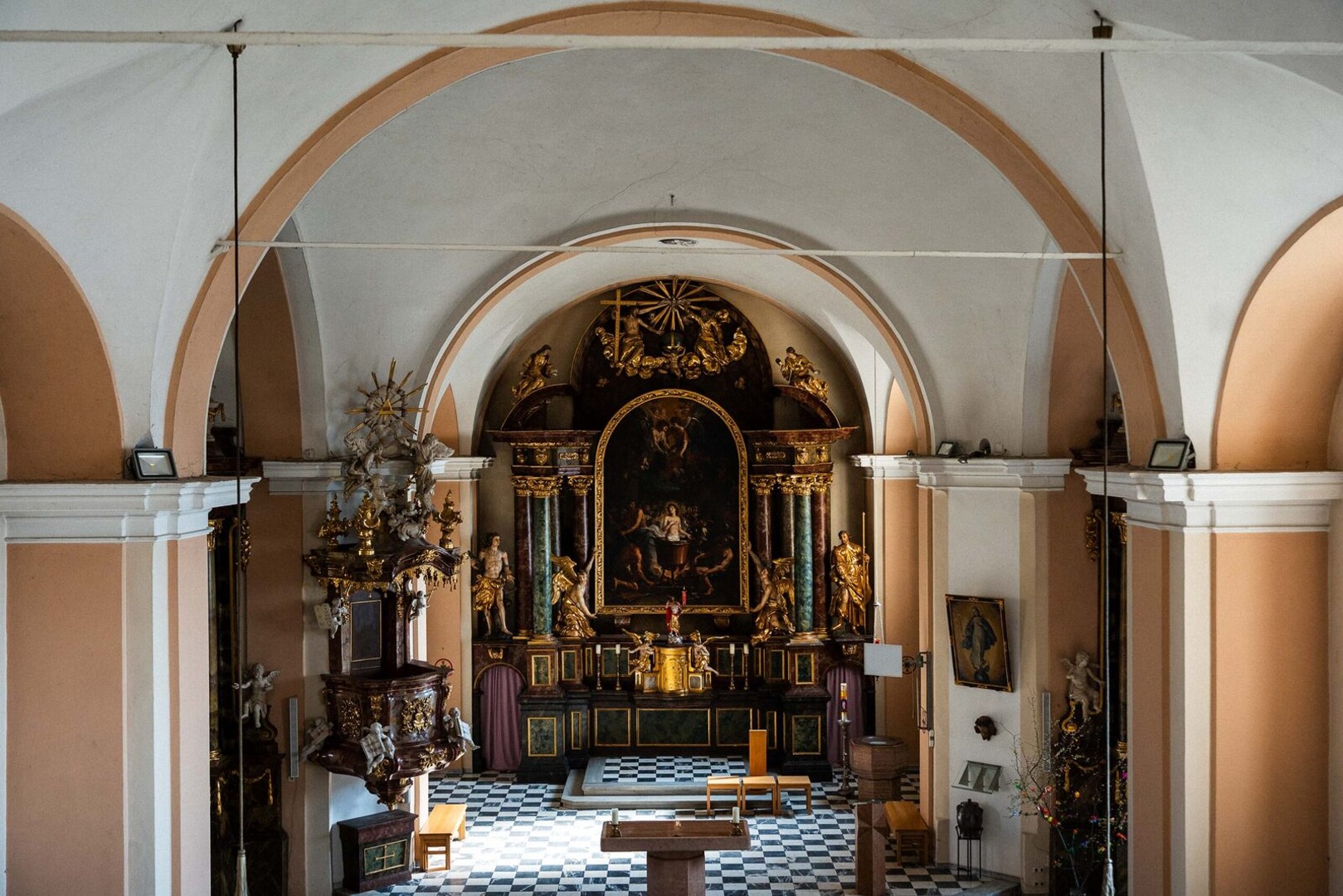
High altar High altarLocation: Choir room (east) Dating: around 1685 (altar painting signed and dated 1680) Material/Type: Wood, marbled, Corinthian columns, acanthus decor Artist / manufacturer: Andreas Marx (sculptor), Hans Adam Weissenkircher (painter), Philipp Jakob Straub (additions around 1745) Foundation of Prince Johann Seyfried von Eggenberg, who held bailiwick rights over St. Veit. The altarpiece shows the martyrdom of St. Veit in the boiling oil cauldron and is the earliest confirmed work by the court painter Hans Adam Weissenkircher. The statues of the plague saints Sebastian and Rochus as well as Mary Magdalene and Barbara are by Andreas Marx. Around 1745, Philipp Jakob Straub added the kneeling angels and the Trinity group to the altarpiece.Read more pulpit pulpitLocation: Northeast corner of the choir arch Dating: around 1740–1745 (ornamental vases added in 1791) Material / type: stucco marble, gilded foliage and bandwork ornament Artist / Manufacturer: Jakob Peyer (Rococo decorative vases, 1791) The pulpit has four putti with the Gospel books as well as reliefs of the Holy Scriptures and the burning heart on the pulpit basket. On the back wall, two angels with Moses' tablets of the law and the cross proclaim the Ten Commandments and salvation. On the sound roof, angels and putti worship the Tetragram (God's name Yahweh) as a symbol of the Trinity; the decorative vases were added by Jakob Peyer in 1791.Read more Marian altar Marian altarLocation: Right branch (south) Dating: 1786 Material / type: wood, Corinthian structure, Josephine-classical carved decoration Artist / manufacturer: Veit Königer (possibly with Josef Königer or Josef Pogner) The altarpiece shows the Holy Family (“Holy Change”). The side figures are Archangel Michael with a flaming sword and scales and John the Baptist in fur clothing. In the altar excerpt, the instruments of suffering held by angels and putti refer to the Passion of Christ and establish a thematic connection to the cross altar opposite.Read more Cross altar Cross altarLocation: Left branch (north) Dating: 1786 Material/Type: Wood, carved, Corinthian construction Artist/Manufacturer: Veit Königer Shows the crucified Christ (three-nail type) in front of a painted backdrop of Golgotha and Jerusalem. Contrary to iconographic tradition, John the Evangelist stands to the right and the Mother of God to the left of the crucified man. An angel in the altarpiece holds Christ's cup of passion as a symbol of the Eucharist.Read more Baptismal font Baptismal fontLocation: choir room (since 1976) Dating: around 1460/1480 Material/Type: Red Marble, Octagonal Late Gothic baptismal font from the church's previous medieval building and one of the oldest surviving objects. It was installed in the choir room in 1976 as part of the liturgical redesign.Read more Picture panel: Life of St. Veit Picture panel: Life of St. VeitLocation: Turmjoch (entrance area) Dating: around 1570/1590 Material/Type: Large-format oil painting on wood, twelve image fields Shows the vita of the church patron in twelve scenes: escape from his parents' house, healing of the emperor's son from obsession, martyrdom in the boiling oil cauldron around 304/305. The St. Veit is one of the 14 emergency helpers and will, among other things, against epilepsy (“Vitus Dance”). Such a detailed portrayal of his life story is rare in German-speaking countries and is considered a unique cultural and historical specimen.Read more organ organLocation: Organ gallery (1st yoke of the nave) Dating: 1907 Material/Type: Organ with neo-baroque front Artist / manufacturer: Matthäus Mauracher (Tyrolean organ builder) Today's organ was built in 1907 by Matthäus Mauracher and replaced the previous organ delivered in 1782 by the Graz organ builder Franz Schwarz. The prospectus is decorated with neo-baroque ornamental carvings.Read more Stained glass window “Dancing Christ” Stained glass window “Dancing Christ”Location: funeral hall (cemetery) Dating: Glass windows created after 1960; Funeral hall opened in 1990 Material/Type: Stained Glass Artist/Manufacturer: Josef Fink (1941–2000) Modern “dance of death”: Christ in dancing movement as a symbol of the fact that death makes all people equal and leads them into another dimension. The picture was not created specifically for the chapel, but it has a special effect there in combination with a late baroque crucifix (attributed to Philipp Jakob Straub, around 1750).Read more Parsonage ensemble with arcade transition Parsonage ensemble with arcade transitionLocation: St. Veiter Straße 86 / village square Dating: core 1457, facade/transition 1777/78 Material / Type: Two-story building with hipped roof and dormer windows; three-axis arcade street crossing Artist / manufacturer: Josef Hueber (facade and portal design, renovation around 1777/78) According to the stone tablet, the oldest part of the vicarage dates back to 1457. Together with the sacristan's house, farm buildings and the three-arched street crossing built in 1778, it forms a picturesque ensemble around the old village square. The ground floor has late Gothic ridge vaults, the upper floor has late Baroque ceiling panels.Read more Cemetery chapel Cemetery chapelLocation: Cemetery Dating: around 1808 Material / Type: Rectangular building with apse, arched windows and Corinthian pilaster structure; Building material from the demolished St. Gotthard Castle Church Oldest holdings in the cemetery. The wrought iron lattice wing (3rd quarter of the 17th century) also comes from St. Gotthard Church. In the apse niche there is a sandstone Pietà (2nd half of the 19th century); South of the church is the grave of the composer Anselm Hüttenbrenner (1794–1868), a friend of Franz Schubert.Read more
StoryLegend of Saint VitusRead more dedicationdedicationRead more Renovations & extensionsRenovations & extensionsRead more Special storySpecial storyRead more
High altar

High altar

Location: Choir room (east)
Dating: around 1685 (altar painting signed and dated 1680)
Material/Type: Wood, marbled, Corinthian columns, acanthus decor
Artist / manufacturer: Andreas Marx (sculptor), Hans Adam Weissenkircher (painter), Philipp Jakob Straub (additions around 1745)
Foundation of Prince Johann Seyfried von Eggenberg, who held bailiwick rights over St. Veit. The altarpiece shows the martyrdom of St. Veit in the boiling oil cauldron and is the earliest confirmed work by the court painter Hans Adam Weissenkircher. The statues of the plague saints Sebastian and Rochus as well as Mary Magdalene and Barbara are by Andreas Marx. Around 1745, Philipp Jakob Straub added the kneeling angels and the Trinity group to the altarpiece.
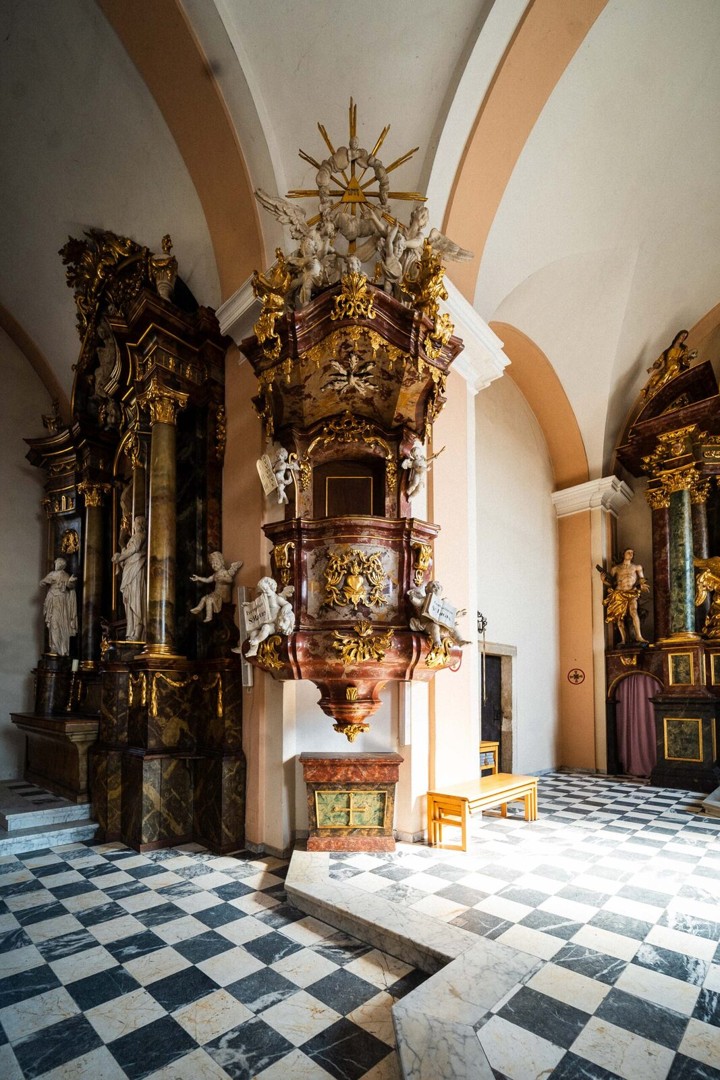
pulpit

pulpit

Location: Northeast corner of the choir arch
Dating: around 1740–1745 (ornamental vases added in 1791)
Material / type: stucco marble, gilded foliage and bandwork ornament
Artist / Manufacturer: Jakob Peyer (Rococo decorative vases, 1791)
The pulpit has four putti with the Gospel books as well as reliefs of the Holy Scriptures and the burning heart on the pulpit basket. On the back wall, two angels with Moses' tablets of the law and the cross proclaim the Ten Commandments and salvation. On the sound roof, angels and putti worship the Tetragram (God's name Yahweh) as a symbol of the Trinity; the decorative vases were added by Jakob Peyer in 1791.
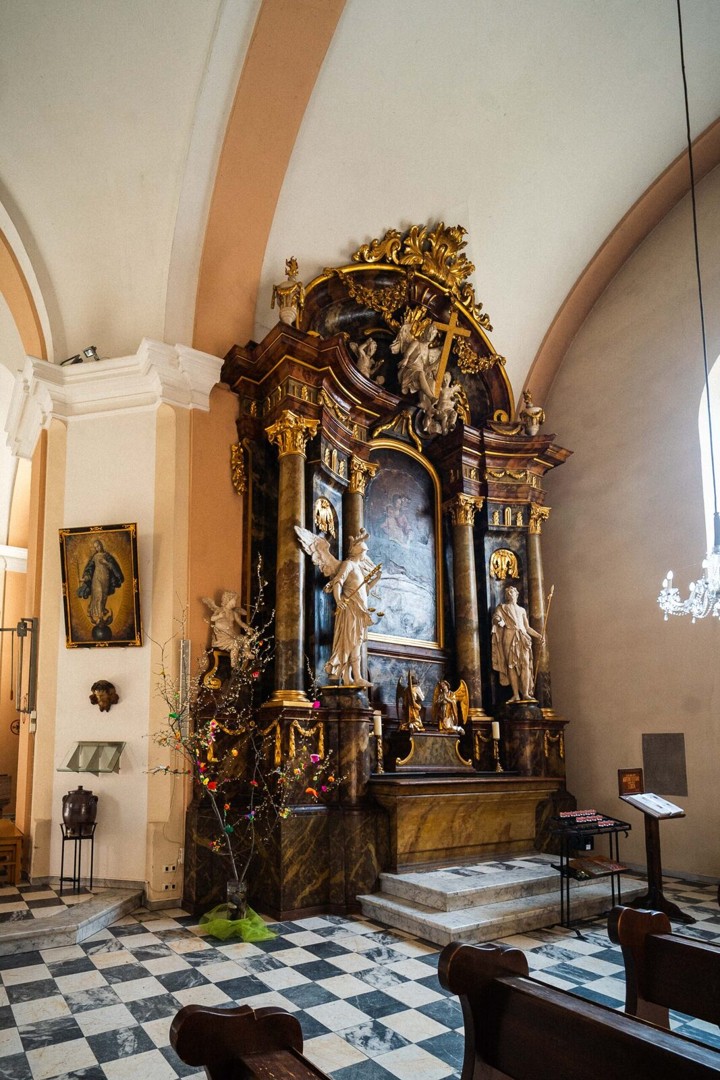
Marian altar

Marian altar

Location: Right branch (south)
Dating: 1786
Material / type: wood, Corinthian structure, Josephine-classical carved decoration
Artist / manufacturer: Veit Königer (possibly with Josef Königer or Josef Pogner)
The altarpiece shows the Holy Family (“Holy Change”). The side figures are Archangel Michael with a flaming sword and scales and John the Baptist in fur clothing. In the altar excerpt, the instruments of suffering held by angels and putti refer to the Passion of Christ and establish a thematic connection to the cross altar opposite.
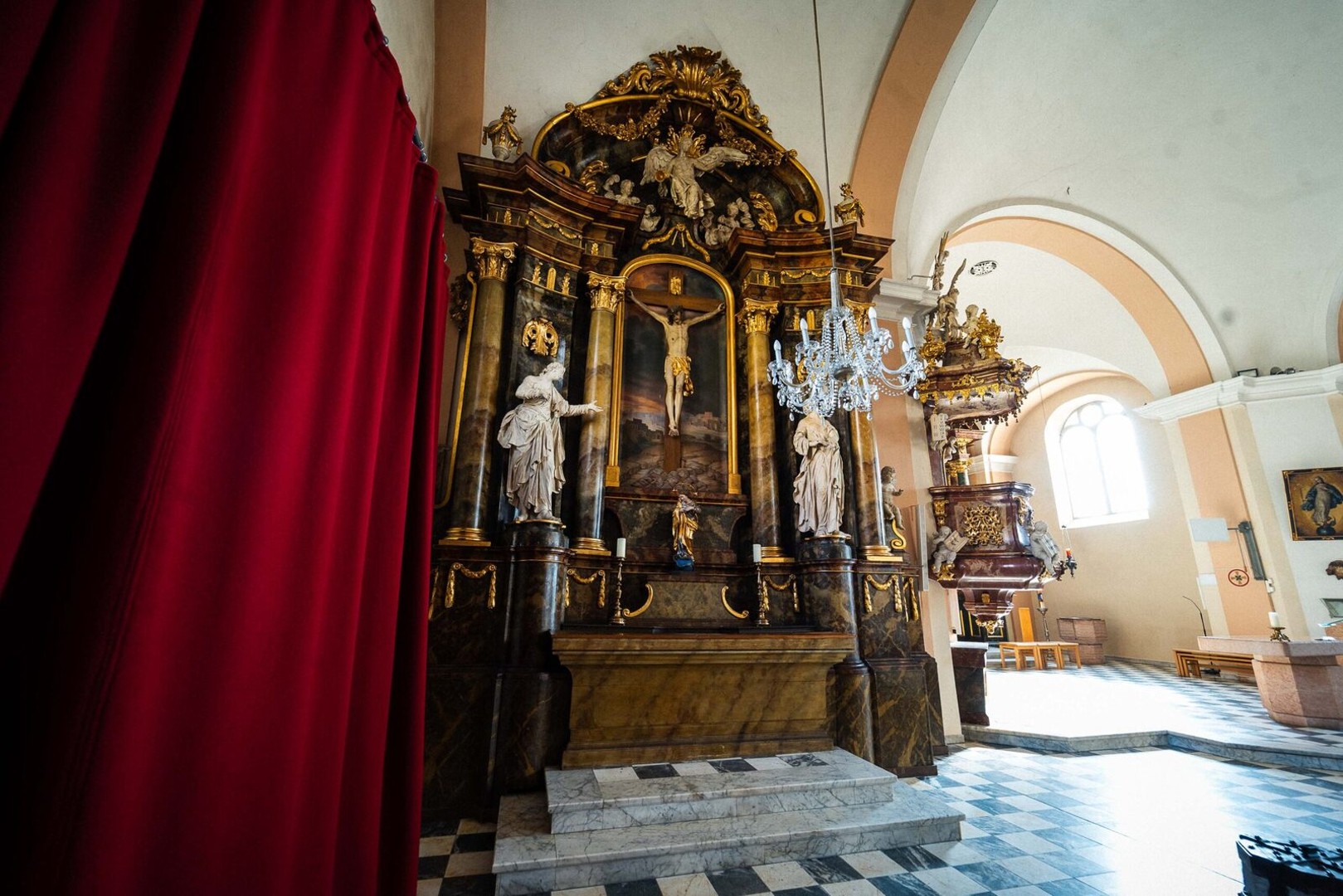
Cross altar

Cross altar

Location: Left branch (north)
Dating: 1786
Material/Type: Wood, carved, Corinthian construction
Artist/Manufacturer: Veit Königer
Shows the crucified Christ (three-nail type) in front of a painted backdrop of Golgotha and Jerusalem. Contrary to iconographic tradition, John the Evangelist stands to the right and the Mother of God to the left of the crucified man. An angel in the altarpiece holds Christ's cup of passion as a symbol of the Eucharist.
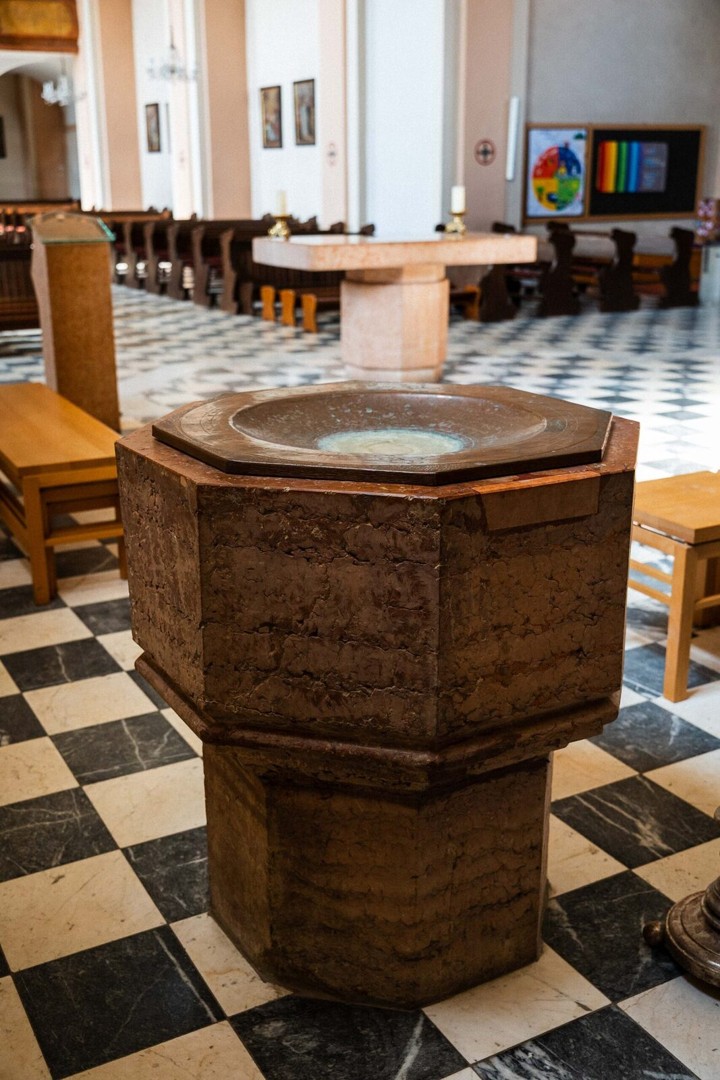
Baptismal font

Baptismal font

Location: choir room (since 1976)
Dating: around 1460/1480
Material/Type: Red Marble, Octagonal
Late Gothic baptismal font from the church's previous medieval building and one of the oldest surviving objects. It was installed in the choir room in 1976 as part of the liturgical redesign.
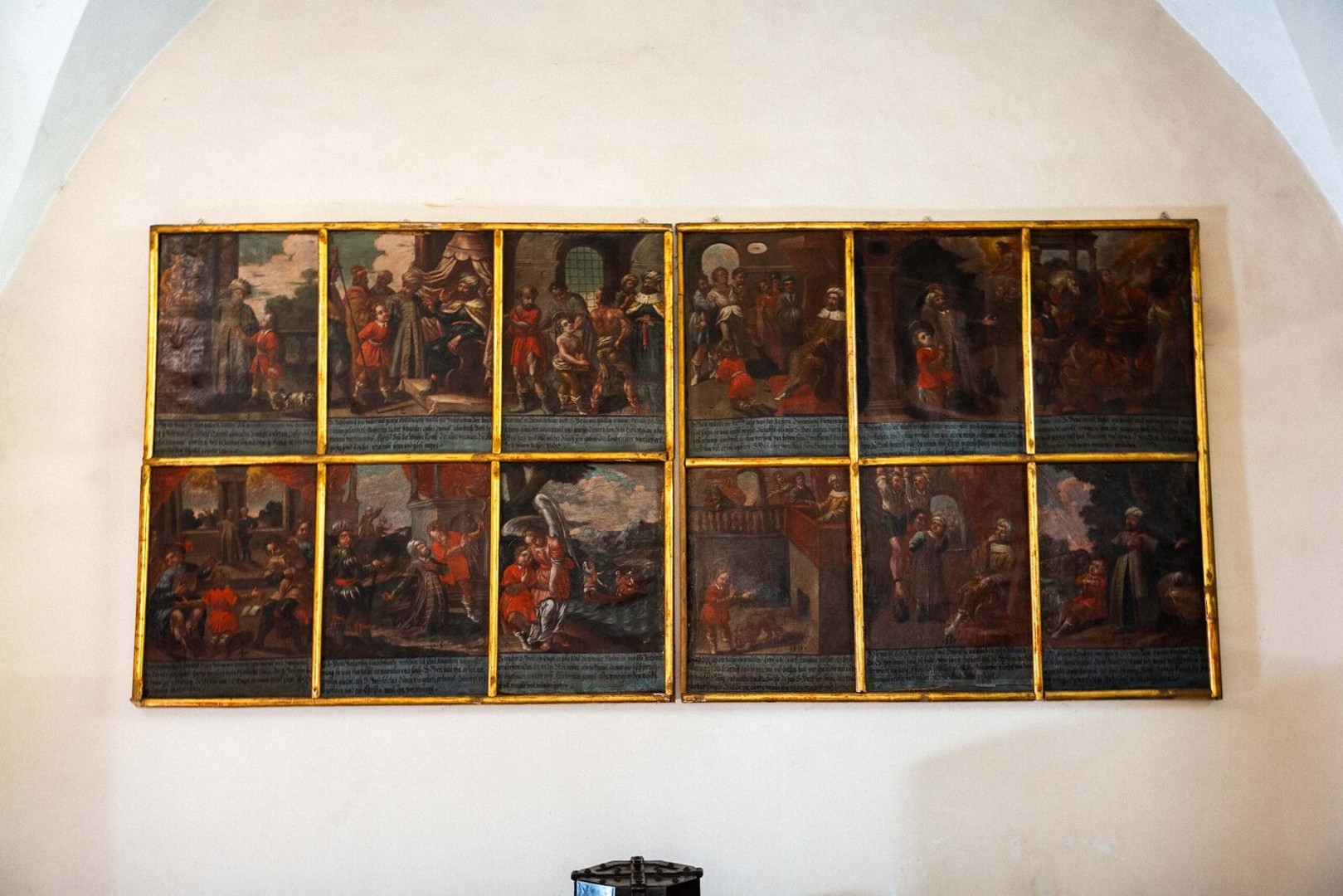
Picture panel: Life of St. Veit

Picture panel: Life of St. Veit

Location: Turmjoch (entrance area)
Dating: around 1570/1590
Material/Type: Large-format oil painting on wood, twelve image fields
Shows the vita of the church patron in twelve scenes: escape from his parents' house, healing of the emperor's son from obsession, martyrdom in the boiling oil cauldron around 304/305. The St. Veit is one of the 14 emergency helpers and will, among other things, against epilepsy (“Vitus Dance”). Such a detailed portrayal of his life story is rare in German-speaking countries and is considered a unique cultural and historical specimen.
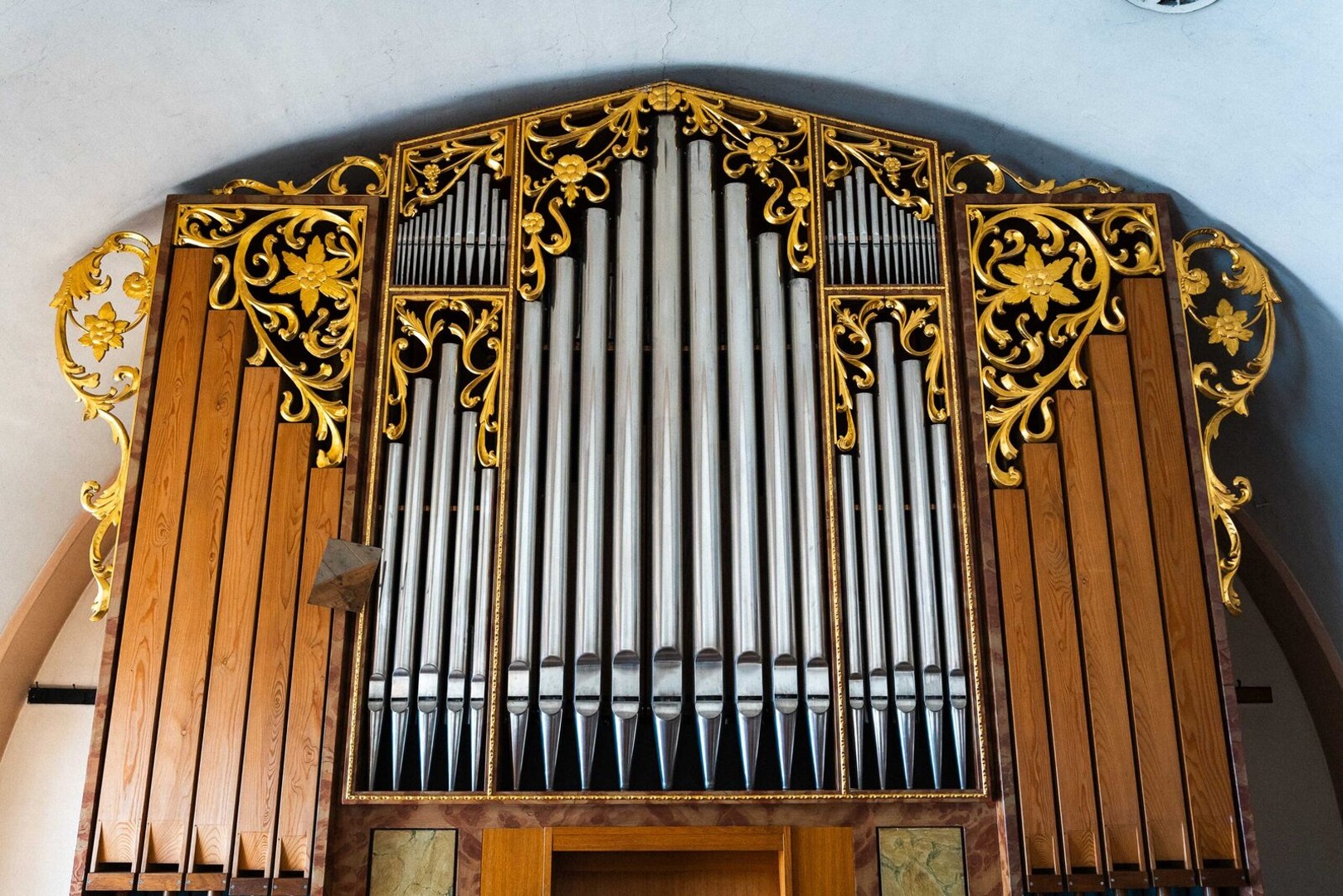
organ

organ

Location: Organ gallery (1st yoke of the nave)
Dating: 1907
Material/Type: Organ with neo-baroque front
Artist / manufacturer: Matthäus Mauracher (Tyrolean organ builder)
Today's organ was built in 1907 by Matthäus Mauracher and replaced the previous organ delivered in 1782 by the Graz organ builder Franz Schwarz. The prospectus is decorated with neo-baroque ornamental carvings.
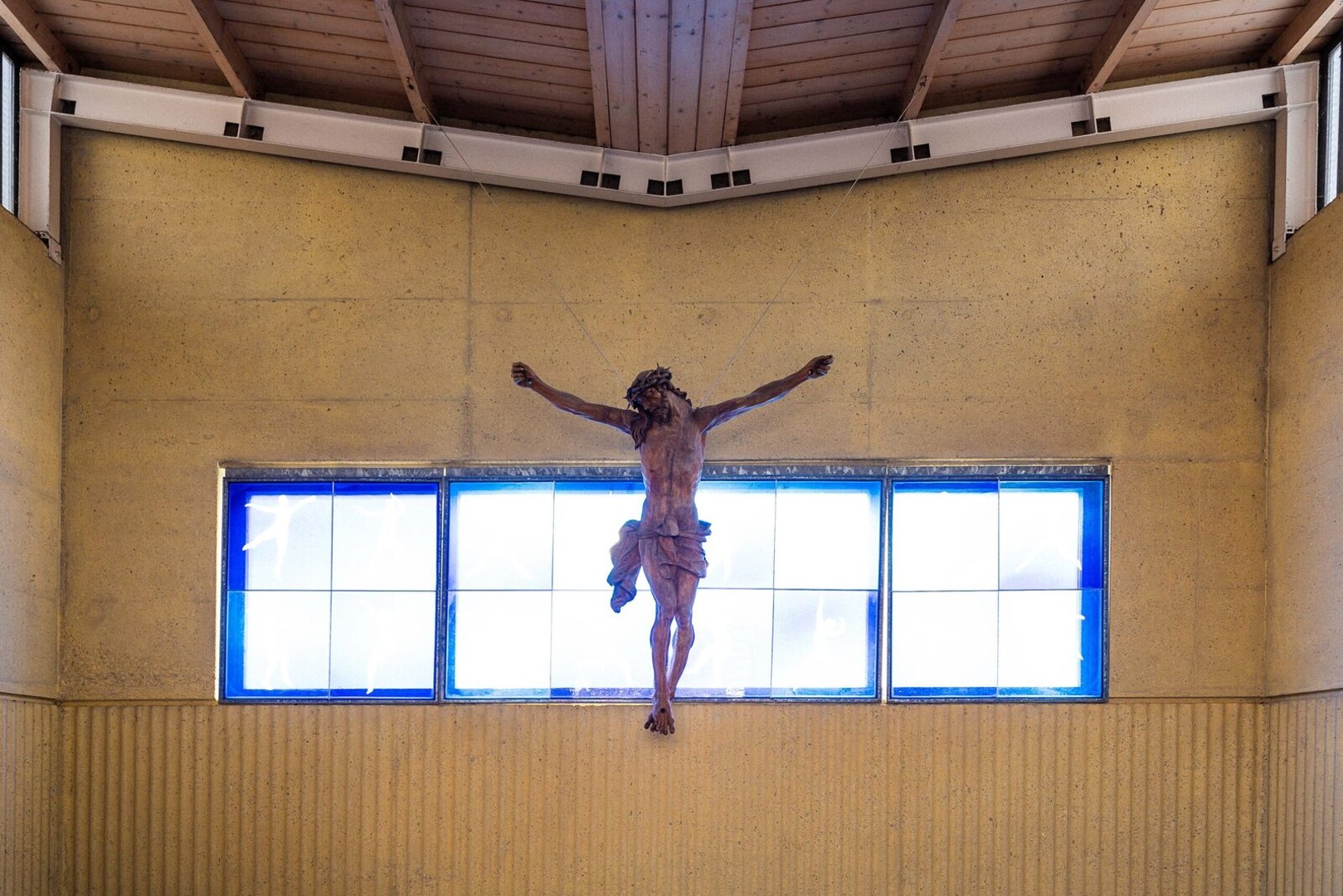
Stained glass window “Dancing Christ”

Stained glass window “Dancing Christ”

Location: funeral hall (cemetery)
Dating: Glass windows created after 1960; Funeral hall opened in 1990
Material/Type: Stained Glass
Artist/Manufacturer: Josef Fink (1941–2000)
Modern “dance of death”: Christ in dancing movement as a symbol of the fact that death makes all people equal and leads them into another dimension. The picture was not created specifically for the chapel, but it has a special effect there in combination with a late baroque crucifix (attributed to Philipp Jakob Straub, around 1750).
Parsonage ensemble with arcade transition

Parsonage ensemble with arcade transition

Location: St. Veiter Straße 86 / village square
Dating: core 1457, facade/transition 1777/78
Material / Type: Two-story building with hipped roof and dormer windows; three-axis arcade street crossing
Artist / manufacturer: Josef Hueber (facade and portal design, renovation around 1777/78)
According to the stone tablet, the oldest part of the vicarage dates back to 1457. Together with the sacristan's house, farm buildings and the three-arched street crossing built in 1778, it forms a picturesque ensemble around the old village square. The ground floor has late Gothic ridge vaults, the upper floor has late Baroque ceiling panels.
Cemetery chapel

Cemetery chapel

Location: Cemetery
Dating: around 1808
Material / Type: Rectangular building with apse, arched windows and Corinthian pilaster structure; Building material from the demolished St. Gotthard Castle Church
Oldest holdings in the cemetery. The wrought iron lattice wing (3rd quarter of the 17th century) also comes from St. Gotthard Church. In the apse niche there is a sandstone Pietà (2nd half of the 19th century); South of the church is the grave of the composer Anselm Hüttenbrenner (1794–1868), a friend of Franz Schubert.
Story

Story

Legend of Saint Vitus

According to tradition, the young Christian Veit was thrown into a cauldron of boiling oil and emerged unscathed - his martyrdom occurred around 304/305. The legend goes back, among other things, to the “Legenda Aurea” by Jacobus de Voragine.

dedication

dedication

Dedicated to Saint Vitus (Veit).

Renovations & extensions

Renovations & extensions

1226: First documented priest of St. Veit (handwriting in Rein Abbey); Starting point for the 800th anniversary 1226–2026
13th century / 1373: Presumably already a Romanesque church building; A rood screen was mentioned in a document in 1373
around 1617: Visitation protocol describes the Gothic church with rood screen, sacrament house and winged altar
1657–1662: New construction of the baroque church under Pastor Johann Baptist Abbt, consecrated in 1662; Builder probably Domenico Sciassia
1685: The existing high altar was donated by Prince Johann Seyfried von Eggenberg
1713: Tower helmet with lantern built by Bartholomäus Ebner and Johann Georg Flexner
1732: Bishop Jakob Ernst Graf Liechtenstein consecrates four altars
1786: Mary and cross altar are rebuilt by Veit Königer
1881/1882: New roof structure, facade renovation with Tuscan pilasters (design Ortwein); The church has a classicist appearance
1907: New organ by Matthäus Mauracher with a neo-baroque front
1972/1976: Exterior and interior renovation under Pastor Josef Kurzweil; Liturgical redesign with a new folk altar made of red marble

Special story

Special story

Legend of St. Veit: The young Christian is thrown into a cauldron with boiling oil and, according to tradition, emerges unharmed - martyrdom around 304/305.
Presumption of a pre-Christian cult site: There may have been a cult site for the Slavic god of light 'Svantevit' on the site of the church; The old place name 'Gabriach' was replaced by 'St. Veit ob Graz replaced.
800th anniversary 1226–2026: The occasion was the rediscovery of the mention of a pastor of St. Veit in 1226 in a manuscript in Rein Abbey.
The stained glass window 'Dancing Christ' by Josef Fink in the funeral hall shows a modern dance of death as a symbol of the fact that death makes all people equal.
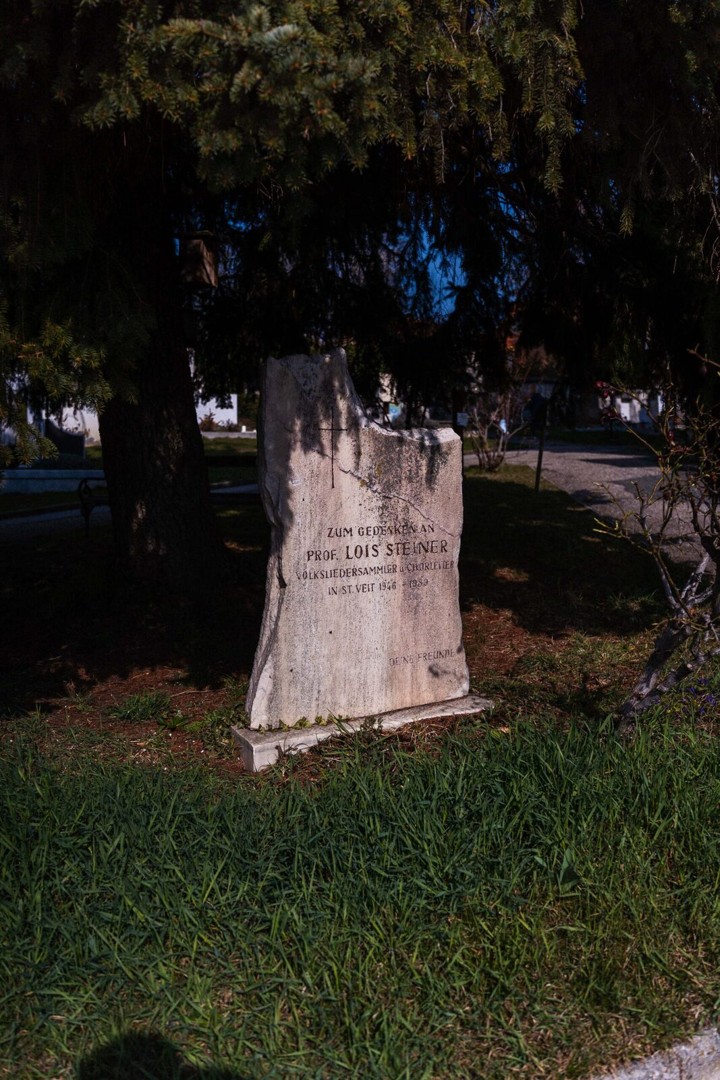
South of the church lies the grave of the music poet Anselm Hüttenbrenner (1794–1868), a friend of Franz Schubert.
The parish includes the Maria Schutz branch church in Kalkleiten, built between 1960 and 1962, with concrete-glass windows based on designs by Alfred Wickenburg and Franz Felber.

Videos

Discover Graz-Andritz · St. Vitus

Sign in